Monday, August 24, 2020

7 Types of Food Commodities

Food Commodities Knowledge: Grain and Rice


What are Food Commodities

  • Commonly consumed foods are those ingested for their nutrient properties. 
  • Food commodities can be either raw agricultural commodities or processed commodities, provided that they are the forms that are sold or distributed for human consumption

Grain and Rice


7 Types of Food Commodities 

  1. Grains and Rice
  2. Meat and Poultry
  3. Seafood
  4. Eggs and Dairy Product
  5. Vegetables and Fruits
  6. Herb and Spices


Grain and Rice

Grain

  • A grain is a small, hard, dry seed, with or without an attached hull or fruit layer, harvested for human or animal consumption


Grain Preparation

  1. Sort through grains, removing dirt or debris
  2. Rinse in cold water until water runs clear
  3. Presoak whole, hard grains (whole barley, oat groats, or wheat berries) to soften and reduce cooking time
  4. For most grains, bring water or stock to boil, then add the grain
  5. Return to a boil, reduce heat, cover and simmer until done - grain will have a slight chewiness
  6. Drain if needed
  7. Fluff with a fork but do not stir otherwise, starches will create a pasty texture


A. Wheat

  • Commonly are planted in the USA, Canada, Europe, Egypt, and India


Wheat Structure


Wheat Structure

  1. Bran: Pieces of grain husk separated from flour after milling. If they contain carbohydrates, it's usually oat bran, wheat bran, or inulin.
  2. Endosperm: The part of a seed that acts as a food store for the developing plant embryo, usually containing starch with protein and other nutrients.
  3. Germ: A nutritious foodstuff of a dry floury consistency consisting of the extracted embryos of grains of wheat.

Types and Uses of Flour


Wheat Nutrients

  • Carbohydrates
  • Proteins
  • Fats
  • B-vitamins
  • Vitamin E
  • Iron
  • Phosphorus
  • Calcium
  • Fiber 


Celiac disease (Gluten-Sensitive Enteropathy)

  • Celiac disease is an immune reaction to eating gluten, a protein found in wheat, barley, and rye.
  • If you have celiac disease, eating gluten triggers an immune response in your small intestine. 
  • Over time, this reaction damages your small intestine's lining and prevents the absorption of some nutrients (malabsorption).
  •  The intestinal damage often causes diarrhea, fatigue, weight loss, bloating, and anemia, and can lead to serious complications.


B. Rice

  • Most grow in Asian countries, China, India, Japan & Korea.
  • The structure is the same as wheat (wheat).
  • Can be short-grain (glutinous when cooked) or long-grain (fluffy when cooked)

Jenis Beras


Rice Nutrients

  • Carbohydrates
  • Proteins
  • Fats
  • B-vitamins
  • Iron
  • Phosphorus
  • Magnesium

Types of Rice

  • Polished Rice/ White rice: It has been milled rice to remove the husk, bran, germ, and varying amounts of the nutrients contained in them, leaving a starch-rich grain.
  • Unpolished Rice/ Brown Rice: it is unpolished rice where only the hull/ husk is removed.
  • Glutinous Rice/ Sticky Rice: It is a type of rice grown mainly in Southeast Asia, Northeastern India, and Bhutan that has opaque grains, less amylose content, and is especially sticky when cooked. 


Types of Rice


C. Cereal

  • Seed grains of cultivated grasses
  • The most common staple food in most countries as they are relatively inexpensive
  • Usually serve as breakfast
  • It can be from Rice, Corn/ maize, Oat, Barley, Wheat, Quinoa, or Millet 


Cereal Base


5 Categories Breakfast Cereal

  • Hot Cereals: Cooked or served hot, can be wholesome and unsweetened and sugary and processed. You can enrich it with honey or fruit.
  • Whole-Grain Cereal: the healthier variant cereal because it has more vitamins, minerals, and other useful stuff for the human body. 
  • Bran Cereal: It has much higher quantities of insolvable fiber. It helps digestion and prevents constipation. 
  • Sugary Cereal: The cereal with high quantities of sugar and has large amounts of additives and preservatives.
  • Organic Cereal: The cereals that don't use pesticides, artificial fertilizers, and no genetically modified ingredients. Their sweeteners are also natural (like honey, or fruit).


Famous Cereal


The Famous Breakfast Cereal

  • Koko Krunch: Nestle
  • Cinnamon Toast Crunch: General Mills and Nestle
  • Lucky Charms:  General Mills
  • Honey Nut Cheerios: General Mills
  • Cocoa Puffs: General Mills
  • Cap'n Crunch: Quaker Oats
  • Frosted Flakes: Kellogg's
  • Froot Loops: Kellogg's
  • Apple Jacks: Kellogg's
  • Cap'n Crunch's Crunch Berries:  Quaker Oats
  • Rice Krispies: Kellogg's
  • Raisin Bran: Kellogg's
  • Corn Pops: Kellogg's


Tuesday, May 5, 2020

Types of Meat Product are Served For Breakfast


Breakfast Knowledge: Breakfast Meat Dishes


Types of Meat Product For Breakfast


  1. Minutes steak
  2. Cured Meat
  3. Breakfast Sausages
  4. Breakfast Patties
  5. Beef Hash/ Corned Beef Hash
  6. Black Pudding


Breakfast Meat
Breakfast Meat
Read: Types of Bread


1. Minutes Steak

  • Minute Steak is a thin (usually 1/4 -1/3 inch thick) cut of boneless.
  • Most often from sirloin or beef tenderloin 
  • Can be served with Green salad, Grilled asparagus, Hash-brown potato, O'Brien potato, Grilled tomatoes, Sauteed mushroom, or Fried egg.

Minutes steak
Minutes Steak
Minutes steak with a green salad and Minutes steak with a fried egg


2. Cured Meat Product

  • Curing is any of the various food preservation and flavoring processes of foods such as meat, fish, and vegetables, by the addition of salt, intending to draw moisture out of the food by the process of osmosis.


a. Beef Pastrami

  • Pastrami is a meat product of Romanian origin usually made from beef brisket. 
  • Main ingredient: Beef brisket or Beef plate 
  • The raw meat is brined, partially dried, seasoned with herbs and spices, then smoked and steamed.
  • Serve as Breakfast carving 
Beef Pastrami
Beef Pastrami


b. Ham

  • Ham comes from the upper part of the hind leg of the pig. 
  • The pork is then preserved via salting, smoking, or wet curing. Ham can come in slices, loaf, or whole leg.
  • Can be served as Breakfast carving (Roasted Ham, Whole leg), Egg Benedict (sliced ham), Omelet (diced ham), etc.

Breakfast Ham
Ham
Ham as Breakfast carving, Ham Benedict, and Ham Omelet


c. Bacon

  • Bacon is a type of salt-cured pork. Bacon is prepared from several different cuts of meat, typically from the pork belly or from back cuts, which have less fat than the belly. 
  • Main ingredients: Pork belly. 
  • Can be served as a breakfast side dish, and Bacon omelet

Bacon
Bacon
Bacon as a side dish, and Bacon omelet


3. Breakfast Sausages

  • A type of fresh pork sausage usually served at breakfast in the United States
  • It is a common breakfast item in traditional American "farmer" or "country" breakfasts.
  • Twice ground pork
  • Heavily seasoned such as black pepper or white pepper and sage
  • Breakfast sausage is normally fried in a pan, grilled, or microwaved.

Breakfast Sausages
Breakfast Sausages


4. Breakfast Patties

  • Breakfast Patties is known as sausage breakfast patties in the US
  • Ingredients: Ground pork as the main ingredient,  and flavoring with sage, black peppercorn, and garlic
  • The size of the patties is like an English muffin

Breakfast Patties
Breakfast Patties


5. Beef Hash/ Corned Beef Hash

  • Hash is a culinary dish consisting of chopped up meat, potatoes, and onions fried. The name is derived from French: Hacher, meaning "to chop"
  • Classic American corned beef hash originated in the New England region of the United States as a way to use up the leftovers from a traditional boiled dinner of beef, cabbage, potatoes, and onions. 
Beef Hash
Beef Hash/ Corned Beef Hash


6. Black Pudding

  • Black pudding is a type of blood sausage originating in the United Kingdom and Ireland. 
  • It is made from pork blood, with pork fat or beef suet, and a cereal, usually oatmeal, oat groats, or barley groats. 
  • Main ingredient: Pork blood and cereal. 
  • Dishes: Serve as a breakfast dish

Black Pudding
Black Pudding


Wednesday, April 1, 2020

Types of Egg Dishes For Breakfast


Breakfast Knowledge: Breakfast Egg


Types of Egg Dishes

  1. Boiled Eggs
  2. Fried eggs
  3. Poached eggs
  4. Scrambled eggs
  5. Omelet
  6. Quiche
  7. Shakshuka

Egg Dishes
Types of Egg Dishes


1. Boiled Egg


First Method

  1. Place eggs in a pot with enough water to completely submerge them
  2. Bring (or return) water to a simmer
  3. Start timing the cooking once the water reaches a simmer and cook to the desired doneness
  4. Evaluate the quality of the cooked eggs


Seconds method

  1. Place water in a pot
  2. Bring water to boiling
  3. Put eggs into boiling water and start timing When done, scoop them out and into cold water (if you’re not eating them straight away) to prevent them from cooking any further. 


Quality Criteria

  • Tender, fully cooked white
  • No green rim around the yolk
  • Yolk cooked to the desired doneness
  • Served warm or cold

Boiled Egg
Boiled Egg Cooking Time

Read: The Top 6 Traditional Appetizer


2. Fried Eggs


The doneness of fried egg

  • Sunnyside up
  • Over easy
  • Over medium
  • Over hard


Method

  1. Heat pan and cooking fat over moderate heat
  2. Break eggs into cups and slide into the hot fat
  3. Cook egg to the desired degree of doneness
  4. Evaluate the quality of the finished fried eggs


Quality Criteria

  • Tender, fully cooked white
  • No color
  • No excess fat
  • Yolk cooked to the desired doneness

Fried Egg
Fried Eggs
Sunny Set Up, Over Easy,  Over Medium, and Over Hard

Read: Baking Method


3. Poached Egg

  • The Popular dishes: Egg Benedict


Method

  1. Bring water, vinegar, and salt to a simmer
  2. Add the shelled egg to the simmering water
  3. Remove eggs when done
  4. Evaluate the quality of the poached egg


Quality Criteria

  • Tender, fully cooked white
  • The runny, yet the warm yolk
  • Delicately set
  • Compact, oval shape
  • Trimmed, if necessary

Poached Egg
Poached Eggs
Egg Benedict and Poached Egg with Toast Bread

Read: The Secret Knowledge to Making The Perfect Sauces


4. Scramble Egg

  • Scramble egg is a dish made from eggs (usually chicken eggs) stirred or beaten together in a pan while being gently heated, typically with salt, butter, and sometimes other ingredients.


Method

  1. Whisk eggs just until yolks and whites are combined; add liquid, if using
  2. Preheat pan and melt the butter
  3. Cook eggs over low heat, stirring constantly
  4. Season eggs, if desired
  5. Evaluate the quality of the finished scrambled eggs


Quality Criteria

  • Small, soft creamy curds
  • Not runny
  • Not dried out
  • Serve warm

Scrambled Egg
Scrambled Egg
Scrambled Egg with Toast Bread, and Scrambled Egg Sandwich


5. Omelet


The Most Common Omelet for Breakfast

  • American Omelet: Folded in half
  • French Omelet: Rolled, no color
  • Italian Frittata: Open face
  • Spanish Omelet: Open face
  • Japanese Tamagoyaki: Rolled Omelet


a. American Omelet

Method

  1. Heat pan and then add the oil or butter over medium-high heat
  2. Add eggs and cook the omelet until the eggs are properly set.
  3. While the eggs are still wet, top them with cheese and other toppings (don't overdo it). Leave it alone until a crust forms along the edge.
  4. Shake the pan gently to make sure the omelet is loose, then use your spatula to flip one side over the other into a half-moon. Transfer to a warm plate and serve immediately.
  5. The Most Popular American Omelet: Denver and the ingredients are Dice onion, diced red and green bell pepper, diced ham, crusted bacon, and American Cheddar Cheese (additional)

American Omelet
How to make American Omelet


Denver Omelet
Denver Omelet


b. French Omelet

Method

  1. Start by gently spreading or flattening the omelet in the pan to even it out for the best-looking rolled and folded omelets
  2. Roll the edge of the omelet nearest the handle toward the center and loosen the omelet
  3. Roll the omelet out of the pan, completely encasing any filling (make sure the edges are caught neatly underneath the omelet), directly onto a heated plate
  4. It may be necessary to shape the omelet with a clean towel

How to make French Omelet
French Omelet
How to make French Omelet

Read: Blanching Method


Quality Criteria

  • Tapered shape to both ends
  • Little to no color
  • Interior like a scrambled egg
  • Exterior smooth - no folds or wrinkles
  • Stuffing cooked and warm if applicable


French Omelet
French Omelet


c. Italian Frittata/ Italian Omelet

  • Frittata is an Italian egg omelet or crustless quiche, enriched with additional ingredients such as Meats, Potatoes, Cheeses, Tomatoes,  Vegetables, or Pasta.

Italian Frittata
Italian Frittata


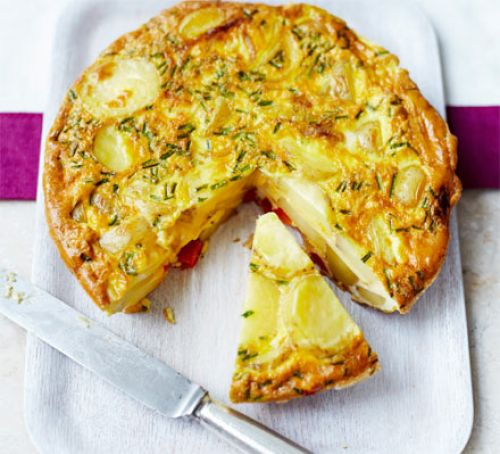
d. Spanish Omelet

  • Spanish omelet is the English name for a traditional dish from Spanish cuisine called tortilla española, tortilla de patatas, or tortilla de papas.
  • It is an omelet made with eggs and potatoes, sometimes also with onion and/or chives or garlic; fried in oil
  • The basic version is made only with eggs and potatoes, and possibly onion
  • It is part of the cuisine of Spain and many South American countries, especially those in the area of the Rio de la Plata.

Spanish Omelet
Spanish Omelet


Spanish Omelet
Spanish Omelet

Read: Broiling Method


e. Japanese Tamagoyaki

  • Tamagoyaki is a type of Japanese omelet, which is made by rolling together several layers of cooked egg.
  • These are usually prepared in a rectangular omelet pan called a makiyakinabe.
  • There are several types of tamagoyaki. It is made by combining eggs, and sometimes sugar or soy sauce. Additionally, sake and mirin are used in some recipes.

Japaneses Omelet
Tamagoyaki


6. Quiches

  • Quiche is a savory open tart or flan consisting of a pastry crust filled with eggs, cream, and cheese, meat, seafood, or vegetables.
  • Quiche can be served hot or cold. It is part of French cuisine but is also popular in other countries, particularly as party food
  • Quiche lorraine (named after the Lorraine region of France) is a popular variant that was originally an open pie with eggs, cream, and lardons.
  • In English-speaking countries, modern preparations of the dish usually include mature cheese (Cheddar cheese often being used in British varieties), and the lardons are replaced by bacon or ham.


The variants of quiche: 

  • Quiche au fromage (quiche with cheese)
  • Quiche aux champignons (quiche with mushrooms)
  • Quiche florentine (spinach)
  • Quiche provençale (tomatoes, onion, black olive and courgettes).

Quiches
Quiches


7. Shakshouka (Middle East)

  • Shakshouka is a dish of eggs poached in a sauce of tomatoes, olive oil, peppers, onion, and garlic, and commonly spiced with cumin, paprika, cayenne pepper, and nutmeg.
  • The dish has existed in Mediterranean cultures for centuries.
  • Some variations of shakshouka can be made with lamb mince, toasted whole spices, yogurt, feta cheese, and fresh herbs.

Shakshouka
Shakshouka


Benefits of Eating Eggs for Breakfast

  • Eggs make you feel full longer than cereal or toast: Protein and fat in eggs help maintain your energy level
  • Eggs are a great source of protein: Whole eggs are one of the most complete sources of protein, meaning they contain all the essential amino acids that we must get from our food.
  • Eggs are cheaper than other breakfast dishes.
  • Eggs help the development and memory of the brain: Choline, an important nutrient found in eggs, stimulates brain development, and function. It has also been linked to increased memory retention and increased alertness.
  • Eggs protect your eyesight: Two antioxidants, lutein, and zeaxanthin are in eggs and have been linked to protecting the eyes from damage related to UV exposure. They have also been linked to reducing the possibility of developing cataracts in old age.


CHEF Q